Tuesday, June 30, 2015

Cool Perfumes


'Cool' as in cooling for hot weather - I'm loving today's mini heatwave!


I posted a feature last summer on perfumes for hot weather, you can read it Here

I don't have too many to add to those choices, they're still some of my favourites, and today I'm wearing Prada's Infusion de Fleur d'Oranger - an uplifting soapy, not too sweet orange blossom.

Other perfumes I'd add to those on last year's list are Kelly Caleche in edt by Hermes - a refreshing grapefruit/floral with underlying leather notes. I'm also finding some of the Middle East-inspired Oud perfumes appealing. That dry, smoky woodiness is also most refreshing in hot weather - not disimilar in effect to vetiver perfumes. One of my favourites is MFK's Silk Mood, which opens on a beautiful light, sweet rose and develops its more Oud-yness into drydown.


Wednesday, June 3, 2015

Aroma M ~ Interview with founder/perfumer Maria McElroy


At last! I have time to post the email interview with Maria McElroy, director and perfumer of Aroma M perfumes.

It's taken a wee while as I've been busy painting for an exhibition about to launch next month.

It's so nice to finally sit down, with a glass of wine (wearing a dab of Aroma M Geisha Noire)  to indulge in some perfume exploration and musings. 

This year, Aroma M celebrate 20 years in the business. So warm congratulations to Maria, her success is well deserved,  because as a niche perfumer she brings an individual creativity, love and dedication to her work that's apparent when you experience the rich diversity, depth and quality of the perfumes, which I wrote about in an earlier post Here

Without further ado, let's meet Maria McElroy..

Rose: Maria, firstly thanks so much for taking time to answer some questions. I’m very curious about the perfumer’s process and inspiration behind the perfumes. 

When I first encountered Aroma M online, I loved the visual aesthetic and the influence of Japanese culture, as I’ve always liked traditional and contemporary Japanese prints and drawings.  

I know you lived there for some years, so can you tell me a little about why you moved there, and how you found living in Japan?

Maria: Rose, thank you for the opportunity and I have really enjoyed our collaboration and learning more about your art.

I went to Japan after graduating from art school. It originally was intended as a kind of world trip with no time line, first to Asia and then to Europe, ending in Berlin. 

It was love at first sight for me and Japan, and I ended up staying and living there for seven years. I adored my time living in Japan; every day was an inspiration and adventure. Even though the culture is so very different from mine growing up in the states, I felt almost immediately at home. The way of living and aesthetic was all encompassing for me, and left a deep impression.
 
R: I’ve heard about the intriguing Japanese incense ceremony where people respond to the scent of incense with a spontaneous poem or haiku. (This sounds mildly stressful, unless you have a talent for poetry!) Can you tell us anything about the ceremony and were you ever a participant or observer? 

M: Incense ceremony, “kodo” the way of scent was my first foray into perfume. 
  
It is very rarefied, a kind of game that was originally played in the “Haien” era court, over a 1000 years ago. 

It is much like the tea ceremony in many ways, you must wear kimono and it takes place in a traditional Japanese “tatami” mate room.  

There are set rules and very specific ways to follow the ceremony. 

Once you are in that atmosphere, for me I was transported into this other place, it was not stressful. “Kodo” has a bit of the Zen mind, where you are perfectly present and in the moment, so everything just flows. That said it is difficult, they say it takes 10 years to start to really understand and be proficient. I still have a long way to go!

R: Can you tell me more about why you wanted to focus on creating perfume? 

M:When I returned to the states after living in Japan, I really wasn’t sure how I would use all my experiences. 

At that time there were almost no small perfume lines, so it took a leap of faith to step into the perfume world. I honestly didn't give it too much thought. I started to bottle some fragrances in my house, and a friend who had a store saw them one day and wanted to stock them. 

The next thing I knew I had orders and boxes everywhere and had to find a separate space for aroma That is how it all started without a lot of thought and here I am 20 years later!
  
R: Learning any art form is a challenge; I find there are usually a few tears and frustrations along the way! Not to mention launching your work, raising interest and making an actual living from it. 

How did you train as a perfumer and what were the challenges? Were there people who were helpful mentors, or supportive to the process?

M: My background is in Aromatherapy. I received a degree in Australia, so all my perfumes have the distinct use of essential oils. 

M: For the most part, the creative process of the perfumes and packaging is very fun for me. I love searching for new raw materials. 

I went to Morocco a few years ago, and was so entranced with the oils there. Many of the ones I found are in my new Camellia Perfume. 

I go to Japan once a year to get the Yuzen papers that we wrap our perfume with, which I love. They have become an aroma M signature.

When I first started there weren’t any blogs, so the magazines were very important. I have been incredibly lucky and have a very thick press book. 

Now with the bloggers it is a different world. I love making new relationships and finding such talented writers and artists such as yourself! I have recently created a separate perfume line, House of Cherry Bomb, with fellow perfumer and scent sister, Alexis Karl. It has been so fun to collaborate with another perfumer and has brought new light into my own creations.

R: I find that your perfumes conjure up vivid colours, images and textures. I liked your description of each perfume being like a beautiful kimono that you slip on to enhance your mood, the season, or occasion.  Can you tell me about inspiration – what usually inspires you, such as art, seasons, music and so on?

M: Thank you so much! The Geishas, and the namesake of my perfume line, are a huge inspiration for me.  Their mystery, glamour and resplendent beauty are always part of each aroma M perfume. From rustling Kimono’s, to the feel of silk on your skin and the mesmerizing way the Geisha dance and walk; I try to translate all that poetry into my perfumes. 

I often think of the fleeting beauty of the Cherry Blossoms and how they have so much in common with perfume, and try to capture that essence in each fragrance. 

Also, I often imagine colors when creating a new perfume. Much like when imagining a painting and putting colors together. 

Aroma M perfumes are named after colors, so this plays a big part in my creative inspiration.

R: When I’ve created a painting, there are a few friends or family members I know will be honest yet kind, who I ask to ‘lend their eyes’ and give an opinion. Who do you ask to ‘lend their nose’?!


Maria McElroy and Alexis Karl
M: Yes, I am very lucky to have my partner in crime and House of Cherry Bomb collaborator Alexis Karl. She is always the first one I share my new perfumes with. I respect and trust her insight implicitly.

R: On that subject, would you like to collaborate with artists, poets, musicians, dancers etc - maybe a development of the Japanese incense and poetry idea?

M: I love the idea of a perfume project using Japanese incense and poetry. You are onto something! I have recently collaborated with very talented collage artist, India Evans, on an art installation that is part of a show that will be traveling from Rome to Naples and Berlin. 

The installation is a room filled with butterflies, all hand cut, floating and spiraling throughout the room, with the sound of fluttering wings and light breathing. It is a joint show of India’s work and her father’s John Evans, who recently passed away and was also a collage artist. The fragrance I created is an ambient scent, but I also created it to be worn as a personal fragrance. 

It was inspired by the love of father and daughter, Rome, and the essence of otherworldly butterflies. ‘Voluptuous Nostalgia’ perfume notes include amber, tonka bean, gardenia, muguet and violet. 
It will be available in limited edition in June. I will announce the details on the aroma M Perfumes Face Book page and website.

R: Some of the best perfumes seem to be inspired by a person or fictional character. Which person/character would you love to create a perfume for? It can be anyone you know, or famous - real, fictional, living or dead! And what would the perfume be like?
  
The first time I saw Max Ophuls masterpiece “The Earrings of Madam De”, I fell in love with the main character Louisa and felt a strange affinity with her. I have been known to have a streak of the dramatic in me, and Louisa most definitely is dramatic.  

The fainting spells aside, Madam De embodies beauty and elegance effortlessly. She is my dream alter ego. 

The film glitters and dazzles, and beneath the artifice, creates a heartbreaking love story that takes place in Vienna a century ago. The film is famous for its elaborate camera moves. 

It follows the lovers adorned with gowns, uniforms and of course jewelry. Dancing and dancing in grand ballrooms, the camera circles the couple until they are left all alone, their courtship told in a dance. 

What romance. We watch Louisa writing her Baron day after day, with no letter back. 

When they finally meet the Baron tells her “I always answered your letters my love, but I lacked the courage to mail them.” 
Then we see the un-mailed letters torn into bits and flung into the air to become snow- such is bold romance. The movie ends in tragedy as all great love stories do, deep in the misty mountains... a duel. We hear far off gunfire and see Louisa, and she watches from a far, then falls and faints in horror for possibly the last time.
 
The Perfume:

Top Notes: Tuberose, Gardenia, White Lotus and Labdanum.
Middle Notes: Violet, Orris Butter, Champaca, White Cognac. 
Base Notes: Choya Loban, Genet Absolute and Labdanum.R: 

Lastly, where can people buy your perfumes or perfume samples, whether in shops or online?

M: Aroma M perfumes are available on our website www.aromam.com and www.luckyscent.comhttp://www.luckyscent.com/, the Scent Bar in Los Angeles, Tiger Lily in San Francisco and Twisted Lily in New York.
                                               ~~~
And so concludes my emailed interview with Maria McElroy. I wish it could have been in person! I'm definitely going to watch Madame De; wonderful descriptions there. And that perfume! I'm swooning at the thought of it...voluptuous tuberose, tender violets, nostalgic orris. I confess I don't actually know what Genet is, or Choya Loban! But it's these details that make Maria a true creative soul of perfumery.

It's been an absolute pleasure to write up this interview, and who knows, one day we might get the opportunity for more creative collaborations, I just know they'd be full of inspiration and fun!

Tuesday, March 10, 2015

Aroma M ~Geisha Noire, Geisha Violet and Geisha Amber Rouge


I'm currently enjoying an exploration of perfumes by Aroma M, a niche New York-based perfume company owned by Maria McElroy, who is also the 'nose' and creator of its perfumes.

I was so inspired by Geisha Green that I wrote an entire review on it, which you can read Here. Not too long after I'd sampled this I ordered a bottle of Geisha Green for summer, and while ordering thought I'd send Maria McElroy a link to the review. She was thrilled with it - and I was thrilled she was thrilled! It's lovely to receive feedback both ways.

Maria generously included pure perfume oil samples of Geisha Violet, Geisha Amber Rouge and Geisha Noire with the order, so I was in perfume heaven for several days. Then it occurred to me that perhaps Maria might like to be interviewed, to which she most charmingly agreed, so watch this blog space for an up-coming interview with Aroma M founder and 'nose' Maria McElroy!

Geisha Violet
Spring Rain by Liitle Pear on Deviant Art
The weather is beginning to lift into something resembling spring here in Scotland, inspiring fresh perfume choices. All those rich ambers and dark vanillas begin to feel a bit stuffy...

What's needed is a metaphorical throwing-open of windows to let in fresh spring air.

So I was delighted to discover Aroma M's Geisha Violet - a perfume which immediately conjures the mood of spring with very pretty notes of violet and lilac.

The combination of violet and/or lilac can tend, in some perfumes, to smell like posh hand-soap, but there's a freshness in Geisha Violet that reminds me of the scent of crushed bluebells underfoot as you walk through woods in May

It makes me think of Dylan Thomas's The Force that through the Green Fuse Drives the Flower (the title at least, if not content of the poem!).


This chlorophyll infused greenness is just what's wanted as crocuses begin to emerge from the dark wintry earth.The sense is of  spring's tender new shoots and flowers, but there's also a softness and depth to Geisha Violet.

I'd never have guessed that this is thanks to the surprising note of cacao, but once I'd read up on the notes of Geisha Violet I could recognise its almost edible subtle sweetness. It's not a note of recognisable chocolate as such, so this is no gourmand; the fresh green/violet hues of spring form the aura of the perfume, but cacao softens and rounds it. And that's very romantic isn't it? - the idea of flowers and chocolate - Geisha Violet would be an inspired choice for Paris under the light rain showers and sunshine of spring, or of course in Japan during cherry blossom season!

Geisha Noire
I've already described how much I enjoyed Geisha Green, but Geisha Noire is probably a close runner-up if not equal.


It gives the immediate impression of a winter/autumn classic. It has been compared to Shalimar, for example, and there is a reminiscent deliciously deep vanilla in dry down - that torched brown sugar of creme brulee with underlying authentic vanilla pod.

But I'd say that Geisha Rouge is less powdery, more spicy in opening (I don't know all its notes but detect cloves and cinnamon). It feels darker, not floral, but it does share the smoke and the smooth tonka bean 'roundness' of Shalimar, and it has a gorgeous, subtly salty animalic ambergris.

It's without doubt a seductive perfume; more sensual than 'bombshell' in style though. The dry down is delicious and it lasts and lasts; perfect for a winter night's tryst, whether in or outdoors!

(Just a small note re' the two paintings above, which to me suggest Geisha Noire. Directly above is Ivan Kramskoi's Portrait of an Unknown Woman, which I remember featured on the cover of the Penguin classic version of Tolstoy's Anna Karenina. Above is Lovers in an Upstairs Room by Kitigawa Utamaro)

Geisha Amber Rouge

Where Geisha Noire is sensual rather than obviously provocative, Geisha Amber Rouge beckons us into femme fatale-like territory.

Honestly it's like having top grade warm Manuka honey drizzled onto your skin while nearby someone smokes on a hookah filled with rich Arabian tobacco!

This is how Jessica Rabbit would smell, if cartoons were to have a smell! I love Geisha Amber Rouge's rich decadence, and it's one of the most popular from Aroma M from what I gather, having read many reviews. (Though O Cha is perhaps the most popular, also worn by actress Patricia Arquett!

It's distinctly autumn-hued - and like all of Aroma M's perfumes that I've sampled so far, Geisha Amber Rouge immediately conjures up colours and images - a come-hither aura of deep russet velvets, candles and Turkish smoking dens - lovely on a dark and chilly autumn evening.

I look forward to interviewing Maria McElroy in the next few weeks, when I hope to find out more about what it takes to become a perfumer, and to explore the inspiration behind her beautifully evocative perfume creations!


Tuesday, January 13, 2015

Sandalwood trade and smuggling


If you're interested in perfumery then you're most likely aware that sandalwood from Mysore in India is in short supply. Perfumers describe it as the highest quality sandalwood and while I'm no expert on the different varieties, I did once have a pot of powdered Mysore sandalwood and in past decades you could buy it easily in 'head' shops, or shops that specialise in incense. The wood is used in perfumery but also much used for arts, sculpture, architecture and incense.


The scent is velvety and sour/sweet, nutty and slightly 'lactonic' (i./e. milky). It has great longevity so acts as a fixative in perfumes as well as lending rich softness and depth. 
Since Mysorean sandalwood supplies have become depleted this variety has become scarce and extremely expensive (£1500 per kilo) so unfortunately it follows that this sparked illegal trade in Mysorean sandalwood and undermined the protection of depleted forests.

I wasn't aware of the levels of danger and crime involved until my niece (knowing of of my interest in perfumery) gave me a book for Christmas (in graphic novel form) about sandalwood smuggling - On the Trail of Sandalwood Smugglers

It's produced by bath, body and perfume products company Lush and was written by the owners, Agnes Gendry and Simon Constantine, of a UK based perfume and essential oils company, both of whom are keen to source only high quality ethical products. 

The book describes their hair-raising discoveries about sandalwood smuggling, which has involved serious levels of crime including murder, and the battle between Indian authorities and smuggling organisations. The worst of these was headed by Veerappan (a notoriously violent criminal who'd also traded in illegal ivory tusks) whose organisation was finally hunted down after the Indian government offered 1.25 millions for revealing his whereabouts. He and his associates were lured into a trap, a gun battle ensued and he was killed.

To cut a longer story short, despite the efforts of Indian authorities to strictly prohibit the production and sale of illegally sourced sandalwood (there is in fact an official seal on legally procured Mysore sandalwood, but many are willing to overlook this detail for the sake of cheaper sandalwood!) sandalwood production in India is currently not sustainable. Prices have sky rocketed and people who seek legal sources of sandalwood have turned to alternatives in Australia and elsewhere.

As the book points out though, Australian sandalwood exists in sustainable natural form (harvested by an Aboriginal organsiation) but it also exists in mass plantations which have grown sandalwood trees from saplings from Mysore, which unfortunately behave as a parasite in Australian soil, leeching essentials from surrounding natural plants. So again, not sustainable.

Agnes and Simon also discovered one other source of ethical sandalwood, from producers in New Caledonia. Though again, it's an indication of the levels of danger involved that the organisation's leader, Michel Point, passed away in suspicious circumstances.
 
Sandalwood producers, New Caledonia
What's most worrying of course is that this affects the perfume industry; if perfume companys don't carefully research provenance of sandalwood, then it follows that we as perfume wearers may not always know if we're wearing illegally sourced sustainable sandalwood or not. The thought that violent gun crime and the damage of rare trees is involved in perfume smelling good is pretty sickening.

I've not yet researched into the company policy of the various perfume houses on sourcing sandalwood supplies, but intend to from now on. The luxurious, high-end 'front' or branding of companies can hide a multitude of sins (including for example clothes made in tax free zones) and this is an area of  interest for me. During my post graduate studies in museum and gallery curation at St Andrews University, I explored the illegal trade in museum objects. Only a couple of decades ago, leading upmarket auction houses based in London, New York and Paris sold rare artifacts that were illegally sourced (meaning that ancient artifacts were ripped out their historical context, causing damage to sites that were supposed to be protected). Nowadays provenance is extremely strict, but we must be ever vigilant!

In the meantime I'll be following news of developments in Mysore sandalwood with interest, and hoping of course that ethical sandalwood trade in India can be to some extent protected and restored.

You can read more about the illicit trading of sandalwood in this interview with Agnes Gendry Here


Mysore forest in Tamal Nadu region, India

Thursday, December 18, 2014

The Queen of Green: No. 19 (Part Two)


Spring Chinoiserie. Rose Strang 2013

Following on from the Queen of Green: No 19  Part One (in which I looked at at the Eau de parfum and Parfum), today I'm sniffing, as I type, the Eau de Toilette and newest flanker No. 19 Poudre.

No 19 takes subtly different forms across different batches within the post 80s reformulations, never mind the differences between pre and post 80s.

So in testing post 80s samples I'm aware of the heavier reliance on vetiver than oakmoss for a lasting and authentic foresty greeness. (though the contemporary parfum and eau de toilette do contain small amounts).

Vetiver doesn't have oakmoss's slightly salty/marine damp bark quality, it's smokier, more astringent, but in a perfume composition it can lend a velvety, dark green quality, blending beautifully with rose and iris/orris. Oakmoss is lighter in feel, whereas vetiver feels very much of the deep earth (and it is the roots that are used)

In fact, truth be told I'm awash in a sea of notes and impressions right now! So rather than get into pernickety detail when there are 100s of different absolutes and aroma chemicals in these perfumes, I will talk instead about impressions/moods and the more obvious facts such as sillage, longevity, floral, green, dry or woody qualities and so on...


No. 19 Poudre
Jacques Polge, current perfume composer for Chanel, created No.19 Poudre in 2011, along with Christopher Sheldrake (perfume composer for Lutens)

He spoke about the fact that many perfumes owe much to No. 19 and that it was a perfumer's wish, rather than a marketing requirement, to create No. 19 Poudre, just to illustrate in a more contemporary form the classic combination of notes that makes 19 an icon of perfumery.

I'm not alone in finding that it immediately reminds me of my other favourite Infusion d'Iris by Prada, which was launched in 2007 - gentle, elegant, powdery with the sense of a warm, perfumed woodland breeze.

The velvety soft vetiver/iris lifted by neroli and orange citrus notes is very similar indeed. But the drydown is sweeter, with a sweet musk (possibly synthetic white musk?) and less lasting than Infusion d'Iris, whose dry down is more about benzoin/vetiver (warm/woody, soft/green). Some will find this prettier than Infusion d'Iris I imagine.

To me, Poudre doesn't really say No 19, as much as make a statement that Chanel were here first. They're right - it's why I immediately liked Infusion d'Iris, which reminded me of No 19.

Poudre is pretty, soft and gentle, not floral. Focused on the powdery aspects of iris (hence the name!) which can be more rooty, starchy or cox's pippin apple-like in other perfumes depending on how it's handled. (Here's an earlier post about iris Iris Perfumes)

There's very much less iris/orris in this than there is the parfum, which has immediate and distinct iris notes. In general, I'd wear Infusion d'Iris rather than Poudre, as I'm not so keen on the sweeter dry-down (perhaps due to the note of tonka bean which is quite sweet) but I can see what Chanel were getting at - here's a contemporary version of No 19, and let us not forget that Chanel (or perfumer for Chanel, Henri Robert) was here first in the 70s with this ground-breaking cool green floral.

No. 19 Eau de Toilette
With the Eau de Toilette we're back on familiar territory.
Here is the more bracing feel of No. 19 as we know it - it has a cooler feel, far more floral. There's oakmoss here, at least in a small amount. The florals are all those that lend a spring-like feel - hyacinth, rose and lily of the valley (bright, clean/soapy) and narcissus (creamier, richer but fresh too).

I find the Eau de Toilette delightful, the mood is uplifting, tonic-water-like, which is why it's so suited to hot days (what's more delicious than a tall glass of iced tonic water and lime in hot weather?!). Though it must be said there's no obvious citrus in the Eau de Toilette (a small amount of bergamot) it's more as though the scent from nearby spring hedgerows is drifting past on a warm breeze while you sip pure icy tonic-water. I love it!

No 19. Poudre doesn't seem so strong on galbanum, with its bitter green tang, than the parfum and eau de toilette, which is why it's probably most suited to people who prefer their perfume softer, and with what some might term a more pretty quality (sweeter, gentler in feel).

Ultimately, at the end of this exploration of all four versions, my feeling is that the Parfum and Eau de Toilette reflect the spirit of No 19 in its original form. I find the parfum the most elegant, austere and rich. Its elegance is about a classically French, refined blend of spring florals, its austerity in the fact that there's nothing sweet here - any prettiness due to the floral bouquet is tempered with green rooty vetiver, and the mysterious waft of iris/oakmoss.

The Eau de Toilette shares this austerity and elegance, but in a minimalist sense; less rich, more 'natural' in as much as its florals, though similar to the parfum, are lighter, giving way to drier, more savoury facets such as oakmoss and galbanum. I can see what Elena Vosnaki of the excellent blog Perfume Shrine means when she descibes it as one to wear with a white shirt and silver bracelets. Exactly. If perfumes can be compared to wine, the parfum and EDT are a cool glass of Chablis, flinty, green, timelessly elegant and refreshing

To round up, here are some of the best blog posts about No 19

http://perfumeshrine.blogspot.co.uk/2013/02/perfume-primers-on-classifying-chanel.html
http://boisdejasmin.com/2006/03/chanel-no-19-perfume-review-vintage-modern.html
http://olfactoriastravels.com/2011/05/27/review-chanel-n%C2%B019/

And lastly, this is Jacques Polge talking about No 19 and the making of No. 19 Poudre
(Click on bottom left of b+w image to play film) -
 http://www.chanel.com/en_US/fragrance-beauty/N%C2%B019-POUDR%C3%89-137626


Spring Sycamore. Rose Strang 2013


Friday, December 12, 2014

The Queen of Green: No. 19 (Part One)


Variously described as 'beautiful' 'haunting' 'icy' 'green' 'elegant' 'feminine' 'complex' 'haughty', 'classy' 'graceful' 'soft', No. 19 (which comes in three perfume concentrations each with its own unique style) can be all of these, and in Part One and Two I'm going to compare these different versions of my all-time favourite perfume, No. 19 by Chanel.

Today I'll introduce a little about the history of No. 19, then describe the Eau de Parfum and Parfum versions, then in part two I'll explore the Eau de Toilette and latest flanker - Chanel 19 Poudre

(You can skip straight down to reviews if the history part sounds a bit tedious!)

No 19 was my first perfume love, and although it was only later on that I began to collect perfume through my interest in Prada's Infusion d'Iris, it's true to say that Infusion d'Iris actually owes a lot to No 19 - in that style of elegant green/iris/vetiver perfumes.

The first Chanel I wore (back in the 80s) was Coco, and while I liked its luxurious scent, given its bombastic 1980s style it really wore me rather than the other way around. I was a creative type, not aspiring to be a high-powered business woman! I tried various perfumes, and on some level I knew that none were right, until in my mid-twenties I discovered Chanel's No. 19.

The strange thing is, I can't remember how it was that in the early 90s I came to be in possession of a 7.5ml bottle of pure No. 19 Parfum. Nowadays this costs around £95 for 7.5ml  (roughly about two teaspoons-full of concentrated perfume).

I wore this as an art student, along with paint-stained, charity-bought clothes, and didn't appreciate what luxury I was dabbing on! I definitely did appreciate the perfume though. I remember its haunting drydown - like the softest perfumed wood-ash, wafting from my hair on a summer's night.

It expressed my love of nature, the peace of forests and meadows, but with something elusive and tantalising, which seemed just on the edge of the perfume. Now, at the age of 47, I'm absolutely aware that green spaces, the countryside, or wilderness, are essential to my peace of mind. It's what I paint about - trying to see beyond the layers. It's also how I earn my living, and this peace is what No 19 Parfum said, and still says to me.

But getting back to the more prosaic matter of that price though - £95 for 7.5mls! I know that those not as obsessed with perfume as I am might be expressing cynicism at this point - aren't we just talking about cleverly marketed branding? Yes and no..

Take No. 5 for example, everyone wore this during the 40s and 50s, Chanel realised that it was becoming ubiquitous and promptly signed up Marilyn Monroe as the 'face of No 5'. In an interview she was asked - 'What do you wear to bed?',

'Chanel No. 5' she replied (although in real life she mostly wore the appropriately fleshy tuberose perfume; Fracas by Piguet). Bingo! The price went up and No 5 became a Chanel exclusive luxury once more.
(update to text, she wasn't paid or signed up by Chanel but did make the remark, which caused sales to boom)

Although marketing does manipulate the human desire for things that are rare or difficult to find, this is not to say that Chanel didn't use the best ingredients, or have the best perfume composers (or 'noses' as they're called).

Chanel own their own fields in Grasse, France, where they've perfected the growth and extraction of perfume staples such as rose and jasmine - both of which feature in the heart of No 5 (giving that perfect alabaster cool balance of clean aldehydes and rose with underlying civet and heady jasmine suggestive of heated skin which No 5's aficionados know and love!).
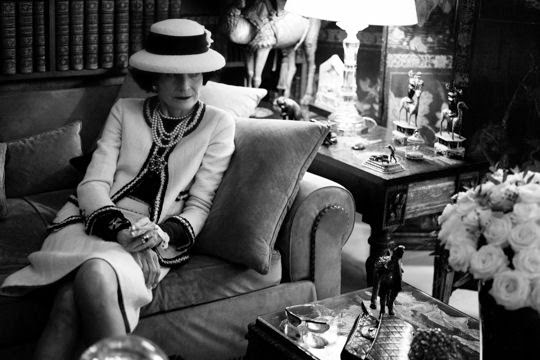

Coco Chanel in her Paris apartment
As for Coco Chanel herself, No 19 (which refers to her birth-date of 19th August) was created for her by Henri Robert, just one year before her death. In an interview at the age of 86 she told this story about No 19;

Coming out of the Ritz, I suddenly felt a hand on my shoulder and I turned around to see an unknown face. I was just about to tell him off in no uncertain terms, when he said to me, with an American accent: ‘Excuse me, I am with two friends who want to know the name of your perfume.’ To be stopped in the street by a man at my age, that’s not bad, is it?

Apparently she occasionally gifted No 19 to a favourite client or friend, but it wasn't released to the public until after her death. And although it never became as popular as No 5, it's always had its devotees. No 19 isn't everyone's cup of tea; on opening especially its notes are green, it lacks vanilla or musk, or any of the ingredients that traditionally make a perfume 'sexy', or typically feminine. It's often described as an 'ice-queen' or 'bitchy boardroom' perfume.

The 1971 launch campaign (which I don't remember as I was only 4 years old!) promoted the idea of an emancipated up-front sort of woman who's ditched her corset (as indeed Coco's fashions famously encouraged women to do). It was seen as the opposite of a demure wallflower - men of a traditional or gentle disposition might even find the woman who wears it intimidating, the adverts seemed to imply.
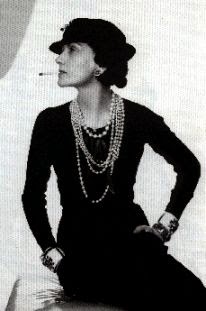

Coco Chanel in the 30s
Tanya Sanchez (who co-wrote the blockbuster perfume book with scientist Luca Turin - 'Perfume: The Guide' ) famously describes 19 as 'wire mother' as opposed to a more 'snuggly' mother. She adds that it's for 'women who have ever wished to know what it is to be heartless'. (on reading this I imagined a great fluttering of paper across the globe, as women everywhere threw their copy of 'Perfumes; The Guide' across the room in disgust while from the grave Coco puffed angrily on her cigarette)

It's an amusing, if slightly strange summary of a classic by a perfume critic, who would be aware of the different versions of No 19 - from the slightly icy and bracing Eau de Toilette (perfect for a hot summer) to the soft, classic floral EDP, and on to the deeper, more haunting pure Parfum.

Perfumers past and present are often indebted to 19, or inspired by it. Perfumer Bertrand Duchaufour, who creates perfumes for the world's top perfume houses, describes his first reaction to it:

The very first memory was when I was 16 years old, when I left my province and I went to Paris. At that time I met a girl who became my girlfriend. She was a student like me and she was passionate about perfumes. She wore Chanel No 19, a beautiful fragrance and I was completely amazed by this fragrance on her skin. Until then I had no interest in perfumes or any kind of scent. 

As mentioned, Chanel's No. 19 is in three very different concentrations which, amateur though I am, I'll now describe to the best of my ability. If you were so inclined you could probably spend a lifetime exploring the various vintages, but for our purposes I'm focusing on those available today (which are definitely reformulations with less oakmoss since that's been increasingly restricted since the late 80s).

The question is, which 19 would suit you?!

Generally the strength of perfume depends on how concentrated the perfume ingredients are, in percentage to alcohol and water, i.e.:

EDT (Eau de Toilette) Up to 15% perfume
EDP (Eau de Parfum) 15 to 20% perfume
Parfum (Perfume Extract/Parfum Extrait/Elixir) 40% perfume

Chanel No.19 Eau de Parfum
As mentioned, any perfumes created post-1989 have been reformulated due to restrictions on oakmoss. So one of the first things I notice up close in the Eau de Parfum is the idea of oakmoss. Perhaps they've used a little of the real thing here, but there's also a synthetic version - it's twiggy, dry and crackling like oakmoss, but it's a little more salty and has less of those subtle smoky facets of oakmoss.

Other than that, the main difference between EDT and EDP of No. 19 is that the EDP uses a large amount of Rose de Mai, or May rose. In this post-80s version of the EDP it's soft, dewy and slightly sweet (not vanilla sweet but it has a sweetness).

Oliver Polge (current 'nose' for Chanel) reformulated the EDP in a way that's faithful to the original, but I'd say this version is softer and more floral. Instead of the drydown to oakmoss, there's more vetiver and the iris is subtle.

But it's still No. 19, with the classic green, slightly powdery and astringent notes thanks to iris (which smells quite 'powdery'), galbanum (a resin with a bitter green quality), vetiver (a lemony/smoky/dry scented grass root which has an astringent quality) and leather, most likely a combination of birch tar notes and synthetics to resemble a clean leather (i.e. not suede-like).

There's a complex floral heart of hyacinth, rose, narcissus, lily of the valley and ylang (this probably varies in different formulations) but the main floral note is rose. As mentioned it's a dewy slightly sweet rose, which softens the perfume considerably. (it's possible this is due to the synthetic aroma chemical hedione which lends a moist quality to perfumes, opening up floral notes).

The feeling is still green though, lightly woody (cedar, sandalwood) and softly floral. Into dry down I notice iris more with its starchy inky, perfumed tones. I don't think anything in perfume expresses elegance so much as the combination of leather and iris.

Sillage-wise, I notice when I smell this on others how gentle it is in feel. I think it's the most approachable perhaps of the versions of 19. It's the most obviously feminine, in the sense that its texture is soft, powdery, and as mentioned slightly dewy in feel.

The longevity is quite deceptive, you may feel it's faded, but others can still smell it many hours later - an effect I've often noticed with iris and vetiver.

In summary, this is the softer, more feminine version of No 19 the rose is gorgeous and while it feels elegant and classic, I personally don't think it could be described as 'cold'. 'Proper' might be a way to describe it. In which case, considering that the original was meant to show a hint of daring - 'the up-front Chanel' perhaps it's debatable that this reformulation holds the original character in its entirety!

Chanel No. 19 Parfum
This too has slightly changed in reformulation, again there's more of a floral quality than I remember, but it has the unmistakable No 19 personality - it is slightly haughty and elegant, yet lovely, and into dry-down (thanks to the quality of ingredients) it feels natural. I find that this blends with skin, or lingers on clothes beautifully.

I can't remember if it was No.19 Parfum about which someone said 'this is how Galadriel must smell', but that would be a perfect description! The most obvious opening note to my nose is iris, or orris - which, as it's derived from the bulb of the iris plant, has a starchy quality. (I've described iris in some depth in a previous post Here). Iris tends to feel slightly haunting, or poetic, and there's been a resurgence of this note  in perfumery since around 2008.

Where the EDP is soft and dewy, the Parfum is more lean in feel, more distant perhaps. I sense more vetiver,, lily of the valley and possibly narcissus. In general, the feel is of timeless elegance. Into drydown that lovely perfumed forest quality that I know and love emerges, No 19 reveals its gentle side at this stage; a gentle mossy quality

To summarise (since I've already mentioned elves!) where Arwen might wear the EDP, Galadriel would undoubtedly favour the white and green aesthetic of No. 19 parfum - it conjures up morning light filtering through a canopy of trees, the scent of perfumed wood smoke lingering in the ashes of yesterday's fire, lily of the valley beginning to emerge from the mossy roots of an ancient oak. Peace and silence reign in the forest.


In Part Two, I'll explore the Eau de Toilette and the most recent flanker - No 19. Poudre