Tuesday, June 10, 2014

Geisha Green by Aroma M ~ Chinoiserie!


I have a thing about Chinoiserie - a European take on all things oriental, somewhat exuberant in style and meaning 'Chinese-esque' in French

And I've always loved Chinese ink drawings, or Japanese prints by artists such as Hiroshige and Utamaro.


This theme of nature, expressed with highly stylised delicacy, seems to be carried into Japanese incense, and one of my favourite brands, Kousaido, make an incense called Ume, which has a lovely powdery floral delicacy.


In my last post I described the citrus/floral sherbet-like powder of Cuir Fetiche, and how that in turn reminded me of a discontinued soap by Crabtree and Evelyn called Coppelia.


The powdery quality I seek (more talcum powder than face-powder) is elusive, because there are certainly many powdery perfumes out there, but very few I like.Thus does perfume lead us into a labyrinth of wish and discovery! Sometimes it's frustrating, but most of the time I find it life enhancing.

While Cuir Fetiche is powdery, it's also an animalic perfume - sensual rather than porcelain-doll pretty in its powderyness, so I was delighted with the recent discovery of Aroma M's Geisha Green (launched in 2010).

This has the kind of powder I love - delicate, citric and sherbet-like.

It ties all these loose threads together for me conceptually; the beautiful mannequin - Coppelia - in the ballet of that name, a porcelain, powdery, oriental with hints of green that makes me want to wear a pale green silk dress with chinoiserie-style blossoms, crimson lip stain and elegantly coiffed hair. It's a high maintenance sort of aesthetic, and not one I'd aspire to on a daily basis! But when the occasion calls for a polished feel, Geisha Green is perfect.

It's described as unisex (as many niche perfumes are) and it's interesting to see the power of words and persuasion in marketing at work here - many describe Geisha Green as masculine, and I see no reason why men shouldn't wear it - I'd never in a million years discourage either gender from ignoring marketing nonsense about the gender of smells!

But I'm here to tell you, Geisha Green is powdery, it's 'perfumey'! It has no traditionally 'male' notes such as strong woods or powerful aromatic herbs.
It is green though and has a most unusual liquorice-like note of absinthe (the 'green fairy' traditionally sought by angsty artists such as Gaughin and Van Gogh).

I begin to see associations of wild imps, elves and forest dwelling nyads or dryyads of mythology, not necessarily good fairies, none of your Disney Tinkerbell!

It also has a very subtle, slightly plastic note, and this is why the perfume as a whole reminds me of chinoiserie - it's a witty take on the idea of oriental style; green, powdery, recalling the orientalism explored by the Post Impressionists, echoing the doll-like make-up of Geishas.

This perfume was created by Maria McElroy, founder and owner of Aroma M, who lives in the US. Maria McElroy was inspired by Japanese culture having lived there for several years where she studied Kodo, the ancient art of fragrance, Ikebana, Japanese flower arrangement, Koto, Japanese harp, Shiatsu massage and Zen Buddhism.

McElroy's perfumes use a high quantity of natural ingredients and are very balanced in feel. There's an abstract quality, plus a defined and distinctive tone to each perfume that's often lacking from smaller niche brands, especially those who use naturals, which can end up becoming a gloopy, muddy mess in the wrong hands.

The opening is more unisex, with distinctive green notes that have an aromatic feel, then within minutes this morphs into a strange green-lit damply powdery violet with aserbic/sweet hints of blackcurrant and mandarin, warmed in its deeper notes with amber and tonka bean.


It's strange, slightly unreal and oddly delicate although the sillage is robust.

And into my mind tumble images of green-glazed porcelain, geisha women, chinoiserie wall paper, evil fairies, Gaughin lost in a Tahitian green-lit forest...it's imaginative and good fun, it brings out the child in me and I just want to dress up - bring on the Edinburgh Festival and summer parties!

Wednesday, May 28, 2014

Iris Perfumes


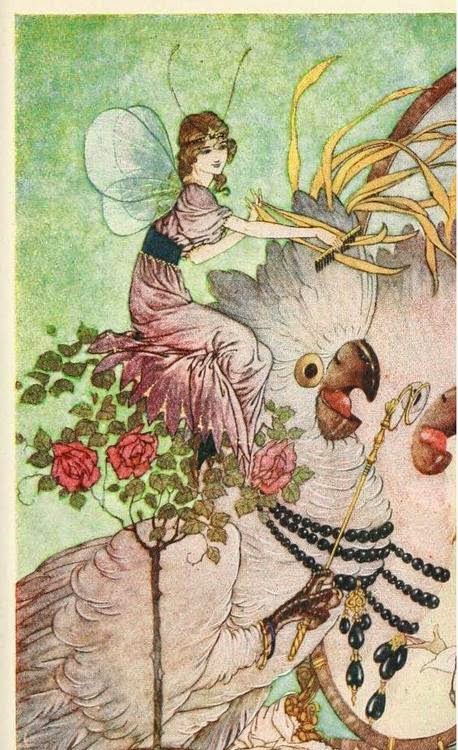
Illustration by Arthur Rackham

Iris is probably one of the most fascinating perfume ingredients; variously described as mysterious, perfumey, starchy, rooty, chalky, mineral, metallic, scenty, nostalgic, elegant, classy, bread-like, funereal,  and any other number of descriptors. It's quite incredible that a simple floral root (orris as it's called by perfumers) can conjure so many moods and aspects.

Visiting a Chanel boutique one day, which had a desk containing basic perfume ingredients in little bottles, I was able to smell iris  in absolute.

Without additional factors to enhance its qualities, it does smell chalky and starchy - almost like sliced raw parsnip or potato; quite difficult to describe - the rooty, dusty/mineral perfumed scent of parsnip is somewhat similar.

For the last century, it's been an important note in high-end perfumes, lending the distinct 'perfumey' quality so difficult to describe. I'd also compare this scentiness to clean cat fur - a sort of subtle haze, though I hasten to add there's nothing cat-pee about it! Orris extract used to be one of the most expensive perfumery ingredients, but recent developments in extraction methods have made it more affordable

Almost all of the best Chanel perfumes feature distinct note of orris - Chanel No.19, Cuir de Russie and 31 Rue Cambon to name a few

But there are quite a few perfumes which feature orris almost as a solo note subtly enhanced with other notes, and if, like me, you love iris, you'll enjoy testing and comparing these different versions.

Iris isn't an obviously seductive scent, at least not in the sense of hot and spicy, or creamy, sweet and gourmand. But it does have its own seductive appeal in the sense of elegance, mystery and a sort of coolness. It's perhaps most suited to moody, rainy afternoons, twilight and autumn evenings - something about its evocative earthy coolness lends itself to these times and seasons

Until I'd sniffed it in absolute and compared the way it's handled in perfumes which prominently feature orris, I wasn't able to easily identify it, since it's not a note like, say, lemon, or woods, which you encounter in everyday life.

I haven't tested iris perfumes comprehensively, but the following perfumes do cover quite a few of the most interesting, popular or respected in this group...

Hiris, by Hermes
Composed by the talented perfumer Olivia Giacobetti, Hiris opens with cool, elegant, slightly crisp notes and a touch of citrus. Its elegant scentiness is immediately apparent but at this stage it can feel a little too cool and haughty. The powdery make-up compact note also feels quite distinct at first, and some may be put off by the initial vintage or classic feel.

If so, then give it a chance to develop because after half an hour on skin it develops beautifully, with subtly warm, woody/nutty notes, chiffon-veiled in a lightly metallic/mineral iris.

It does change personality somewhat - from fur-coated and slightly posh, to natural - dressed in simple raw silk. It's a bit like Diptyque does iris (if you've tried Diptyque perfumes you know what I mean - contemporary, easy to wear, simple in feel). I detect a note similar to nutmeg, and in this sense it has something in common with the dry-down of Giacobetti's Passage d'Enfer by L'Artisan.

A light, yet contemporary perfume which, though a little 'clean' and proper in feel, is nonetheless the perfect perfume if you wish to smell 'together'. It would probably make a good impression for formal or work-related meetings.


28 La Pausa by Les Exclusifs de Chanel
This mysteriously complex scent is a veritable Catherine Deneuve of a perfume - elegant yet animal! It reminds me of rain-drenched trench coats and city streets.

If it was a film I'd imagine it starring Deneuve and featuring an erotic affair with a handsome author or journalist caught up in political scandal.


There's something about 28 La Pausa that lends it a touch of adrenaline - in a good way; a hint of anticipation, nothing like the 'safe' feel of Hiris. I think this is quite a seductive perfume, for certain moods. It's harder edged than Hiris, with more projection and perhaps a slightly androgynous aura.

It's also serious, elegantly minimal and it might scare off the intellectually challenged, you probably wouldn't attract a macho footballer in this (no offense to football fans!). It reminds me of the scent of someone arriving indoors after being in the rain, a touch of ozone, verging on salty, then as they shake out wet hair, scent emanates into the room

This was by 'nose' Jacques Polge for Chanel, which was a surprise to me as I'm not usually a fan of his perfumes (Chance, Coco Mademoiselle, Allure).  28 La Pausa is an outstanding perfume, enhancing (rather than clothing) iris with subtle musk, leather, florals and distinct vetiver in drydown.

Iris Poudre by Frederic Malle
Powdery with a capital 'P', this lavishly powdered iris is by talented nose Pierre Bourdon, who was responsible (alongside Christopher Sheldrake) for the iconic Feminite du Bois. Also Kouros and French Lover.

I love FdB and quite enjoy the sweaty/soapy skank of Kouros for men (though it's inextricably related to the 80s for me, the female equivalent I suppose being Coco Chanel).


So I was somewhat surprised by this abundance of cleanliness and talcum powder - reminiscent of a long bathing session followed by a thorough dusting with large, fluffy blue satin-ribboned powder puff before reclining on a chaise longue in silk robe and indulging in a crystal bowl of strawberry bob bons, coated in pink vanilla icing sugar.

If that sounds like a pleasant way to spend your afternoon, then this is for you! I find it distinctly sexless (you'd never find me wearing pink fluffy mules around the house). In a sense it reminds me of Malle's Lipstick Rose - it could be experienced as old fashioned, or wittily retro. Either way, my style doesn't match up with this tweedy-handed yet undeniably clever and evocative perfume. Iris has powdery elements, in as much as iris/orris was often used to scent face powder and talcum powder, so it's very much about association and in the appropriately named Iris Poudre this aspect is enhanced. Into dry down it loses some of its flounce by becoming a little more woody. On clothes it retains its powderiness to eternity, and beyond.

Strangely, it also reminds me of a posh Edinburgh lady from Morningside (Morningside is where 'sex' is what the coal arrives in - sacks - it's the accent!). Behind closed doors those ladies probably did, or do, indulge in elaborate powdery rituals before their banker husbands return from the office!
Notes: Tonka bean, vanilla, vetiver, sandalwood, musk, iris

Iris Silver Mist by Serge Lutens
As mentioned, orris is a rhizome, so its perfume has rooty qualities, and where Iris Poudre enhances iris's powdery associations, Iris Silver Mist is all about earth and the vegetal aspects of iris.

It's no doubt this earthy/mineral and rooty quality of iris that leads many to experience it as funereal or sad. But while I find iris quite nostalgic, 'sad' and 'funereal' associations don't enter my mind.

Instead I find Iris Silver Mist grounded, delicious, like roast parsnips, with the sweetness of carrot juice. I absolutely love carrot juice, and I seem to detect carrot seed in this perfume. Or perhaps the rooty aspect of orris simply smells carrot-like.

I like the idea of a savoury gourmand; this perfume makes me feel quite peckish - I feel like roasting root vegetables in the oven! The elegant, mysterious air conjured up by many iris perfumes is present in Iris Silver Mist but less refined, more earthy in feel. What I do notice is that, of all the iris perfumes I've tried, this smells the most alike to the pure orris extract I smelled in the Chanel boutique. It feels authentic, and since Lutens always aims to include high quality naturals in his compositions it comes as no surprise to hear the story of its making. Lutens apparently wanted the iris mood heightened, so perfumer Maurice Roucelle added every natural iris absolute and iris synthetic available, to create this ultra enhanced irisy-ness.

While it lacks the elegant mystery perhaps of 28 La Pausa, or the delicacy or Iris de Nuit (see below) it does enhance the chalky, starchy/sweet and rooty facets of iris so the overall effect is grounded, somehow suggesting strength and depth of character. It's darker and wilder in feel than the groomed urbane aesthetic of 28 La Pausa, or the healthily clean Hiris and in this sense it has an appealing mood of earthy intrigue

Infusion d'Iris by Prada
Earlier review Here (scroll down to review)
Infusion d'Iris is, despite its name, is more about citrus, florals and vetiver than iris. But the idea of iris is here in the subtle make-up and powder notes. It's what made this a surprising launch from a mainstream company such as Prada, going against the tide of sweet, fruity gourmands. It's one of my all-time favourites - very easy to wear, drying down to soft, earthy vetiver.

Iris de Nuit by James Heeley

The inky quality of iris is enhanced here. I use ink as an artist fairly regularly so I'm familiar with its earthy smell. Iris de Nuit balances this with violet and cedar to create a gentle, romantic mood. I always think of this as a perfume for poets
Earlier review Here (scroll down to review)

Other iris/orris perfumes worth trying..

Iris Nobile by Aqua de Parma
Iris Ganache by Guerlain
Iris d'Argent by Keiko Meicheri
Iris Gris by Legendary Perfumes 
Bois d'Iris by The Different Company
Hermessence Iris Ukiyoe by Hermes
Iris by Yardley
Heure Exquise by Annick Goutal


Friday, February 7, 2014

Musk

(To skip straight to perfume reviews, scroll to the bottom of this article)

Sweaty, indolic, faecal, animalic, catty, urinous, warm, glowing, barnyard.. 

All are terms used to describe 'musk' in perfume, and with the exception of 'glowing' you'd be forgiven for wondering why anyone would want to spray such essences on their skin in the form of perfume.

But as Duchamp's Urinal attests, it's all about context!

I'm neither a perfumer nor a chemist, so I'm not going to go into any great detail about the components of musk and its myriad manifestations in perfume. (for those of you with a deeper interest in perfume chemistry though, I highly recommend this 3-part series from the the perfume blog Perfume Shrine: Musk -  Series 1  Series 2  Series 3 )

Suffice to say, musk in perfume can be natural or synthetic, but nowadays for ethical and economic reasons it's more often synthetic. Historically, musk pertained to the substance taken from the anal pods of the musk deer, or glands from the civet cat which produce a 'fecal' note, also castoreum from beavers which produced a 'urinous' note, reminiscent of leather

The question is, why on earth would anyone want to smell like cat pee or deer's anus? The simple answer is, partly, longevity. Nature in its wisdom has ensured that smells pertaining to our reproductive organs will be very lasting, also pervasive.

If you add musk to a fragrance, it works as a kind of fixative, and without getting too detailed here, the theory is that it's basically to do with the shape or size of molecules, with musk being one of the more weighty, therefore the slowest to 'take-off' from the skin (lemon would be one of the lightest). This current theory (disputed by some scientists, most notably Luca Turin) is that the shape of these molecules interacts with our nose membranes.

But musk is not just about longevity. In nature many of the smells we love the most -  such as woodsmoke, leather, jasmine, orange blossom, honey fresh from the comb - also contain aroma chemicals reminiscent of our own natural secretions. Jasmine, for example, contains chemicals known as 'indoles' which in isolation smell somewhat camphorous, like mothballs, or even bad breathe, indoles are also present in faeces. Add these to the complex aroma that makes up the scent of jasmine and this facet enhances the flower's heady aroma - an excellent fly and bee attractor too, which is of course why flowers smell. This indolic quality is a feature of many white floral perfumes, which can be categorised as 'clean' white florals, 'animalic' and everything in between

It must be said that these smells are dividers - some people loathe the smell of jasmine and tuberose, others find woodsmoke in perfume too acrid. I myself struggle with tuberose but love both jasmine and woodsmoke. But, perfumers can really 'ramp up', or decrease certain musk smells such as 'urinous' castoreum, or 'fecal' indoles and civet, and when they ramp them up, I often find the results pretty repellent, while others don't even begin to detect these notes. This is because most of us are anosmic to certain musks, they're a bit similar to ultra violet rays, with some being on the edge of our perception.

Its probably a part-inherited trait since my mum and sister are also hyper sensitive to these factors. Appreciation of perfumery means I've developed a tolerance for some of the extremes though (much in the same way as people develop an acquired taste for blue cheese, for example).

Perfumers can isolate, dilute or enhance these effects. In contemporary, mainstream perfumes these 'skanky' factors (as they're known by perfume appreciators and collectors) are often downplayed. These days most people simply want to smell clean and fresh, especially while at work, which makes sense, but only up to a point.

The problem with these 'clean' perfumes is that they often lack complexity and depth - in short, they're boring. The human nose revels in complex aromas (as mentioned, woodsmoke and so on). And this is where musk can play a role in lending complex factors to perfume, reminiscent of, for example fresh sweat

I'll list a small and by no means comprehensive list of musky perfume examples below. But it's worth knowing that synthetic musks play the role of fixative in a variety of ways - some can simply smell clean, yet long lasting. Most washing powders contain synthetic musk because it retains scent despite soap suds normally breaking smells down. So musk can be dirty or clean depending on the effect desired. (it's ecologically fairly unsound for washing powders to contain so much synthetic musk, much more than perfume incidentally)

Lastly, an expensive yet natural and ethical source of musk that's still used in high-end perfumes, is ambergris. This is a by-product of the Sperm Wale's digestive system (I can't remember from which end to be honest!) and when it's first produced it's a foul smelling, tarry looking substance, but miraculously after a year or more floating in the sea it begins to smell lovely - a warm salty/sweet scent that's very distinctive with powerful fixative and 'projecting'  or pervasive qualities which make it ideal for perfume.

Urinous/Fecal
Sounds grim yes? But catty and fecal elements of musk are integral to the iconic perfume Joy, by Patou. This is to enhance the fact that's it's an abundantly rich floral bouquet. I personally can immediately smell a urinous note in this thanks most likely to castoreum (a note which I perceive as either 'fur-pants' or 'men's urinal' - depending on how its handled) and civet (some people think this smells fecal, but to me it's sharply urinous, others detect the fecal note more clearly, and still others smell none of that - just a lovely floral smell! Experience tells me that this 'pissy' or 'urinous' note will fade to produce a warmth that enhances the glowing and radiant floral qualities of Joy. Though it's still a perfume I associate with a woman who wears a long fur coat and files her red nails into talons -very much in a 'grande dame' style. I've read though, that it's current formulation has nothing on the vintage (a most enjoyable review at the Perfumed Dandy's blog can be read here )

Another note which produces a urinous or 'cat-pee' effect is blackcurrant bud - evident in Frederic Malle's Portrait of a Lady where it lends a ruby-red acidic lushness to the powerful rose/patchouli blend, and Annick Goutal's Ninfeo Mio where it combines with green/woody/citrus notes for an underneath-the-bushes effect wonderfully reminiscent of a wild garden in the height of summer.

Chanel's elegant classic Cuir de Russie also has notes of castoreum which, alongside smoky birch tar and a floral bouquet, enhance the idea of animalic yet elegant leather.

Sweaty/Indolic
Penhaligon's Amaranthine is a milky, green-toned beach floral to some noses, but to some people (including me) it's strongly reminiscent of the scent of stale sweat that you can't shift from a nylon top, and groin sweat, more specifically groin sweat from a man with worrying alcohol issues on a salad-free diet. This is followed up in dry-down with a surprise ammonia note, suggestive of advanced kidney failure. Needless to say, I struggle to think up an occasion at which I might wear this! It smells like the tragic and regrettable morning aftermath of a seriously dissipated night out. Others have described it as 'the scent of a woman's inner thigh'. and 'a corrupt floral'. I can appreciate that the musky qualities have been very deliberately ramped up by 'nose' Bertrand Duchaufour (something of a 'rock star' in the perfume world, many of whose other perfumes I find truly gorgeous - Seville a L'aube, Havana Vanille). Amaranthine has very classic female summer perfume qualities (milky white tropical florals, green notes, banana leaf) but Duchaufour deliberately made it very naughty because he wanted to challenge Penhaligon's prissy Victorian image, and as far as I'm concerned he's out-done himself here with this complex cocktail of musks! As mentioned, due to the fact many people are anosmic to the effects of certain musks, a lot of people don't 'get' any of this, just the florals...

Diorella by Dior, now this is my kind of indolic jasmine! To me this is more reminiscent of fresh sweat, and the fact that its lovely jasmine is harmonised with juicy (not sharp) lemon, ripe melon, and green, smoky vetiver makes it a dream-like summer picnic of a perfume. To spray this on is to be transported to the height of summer. It was love at first sniff for me - on the healthy side of sweaty, with a slightly unisex and very relaxed feel. A more lady-like and refined idea of this summer's day paradise can be experienced in  Le Parfum de Therese (my earlier review here).

A more subtle take on indolic white florals is Songes by Annick Goutal. Featuring jasmine, ylang and a small amount of tuberose, Songes suggests a humid, tropical holiday, the indolic quality is subtle, adding a soft, moist feel, it's also given a little depth with the addition of resins which suggest beeswax, and enhance the lovely summery quality

Salty
The previously mentioned ambergris, sourced from the Sperm Whale, is very evident in Andy Tauer's Une Rose de Kandahar. While this perfume features a very high quality Afghanistan rose, to me its most striking feature is the note of ambergris which lends this a tingling marine salty haze - very powerful and long-lasting. A more dilute version can be found in the beautiful Iris de Nuit by James Heeley - (a review can be read here towards the end of the post) paired with green notes and a delicate, cool violet, ambergris lends a subtly warm tone to this ethereal perfume.

Clean haze
The clean-haze effect is most often thanks to 'White Musk' - a sweet synthetic musk, best evidenced of course in the Body Shop's White Musk, also in J-Lo's Glow a pleasantly soapy clean floral scent. 'Cashmeran' another clean-scented musk is used to strong effect in Frederic Malle's  Dans tes Bras. Also, slightly lighter, in Donna Karan's Cashmere Mist where it lends a slightly acidic haze to the perfume. Some people are completely anosmic to this effect, while others find it strangely irritating. I can handle it in Cashmere Mist, but in Dans tes Bras it's like nails on a chalkboard for me -reminds me of the smell of old, oxidised metal coins.

Barnyard
Barnyard pertains to horsey, hay-like verging on manure notes, sometimes with a hint of castoreum. One of the best examples of this can be found in Miller Harris's L'Air de Rien. My earlier review here ). The synthetic musk used in this perfume is known as 'black musk' - darker and heavier in tone. (Though hay-like notes often refer to a perfume ingredient called 'coumarin' - best evidenced in Serge Luten's cosy, comforting Chergui). L'Air de Rien's horsiness is also due to labdanum, a type of resin which can smell hair-like

L'Air de Rien, by Miller Harris is a bit 'hippy' or 'horse stable' for some people, but as with all perfumes, and especially musks, it depends how it reacts with your skin. The horsey notes and lightly mildewed book smell of L'Air de Rien is oddly, but somehow perfectly, paired with sweet incense, vanilla and neroli. Some people say there's no hard evidence to prove that perfumes smell different on different people, but my answer to this is; Do people smell different from one another? I rest my case.

Bal a Versailles, by Jean Desprez
This has orange blossom and labdanum, in common with L'Air de Rien, but the feel is far more classic and formal. Despite its reputation as a musk bomb, Bal a Versailles has a classic suede-glove texture and lovely soft warmth with a salty powdered quality. The musky barnyard quality is slightly leathery, with castoreum adding a cat fur note alongside indolic notes, which will appeal to some but definitely not those who seek soapy freshness in a perfume!  In reformulation it's perhaps less floral and I can imagine it worn by men, in fact it reminds me a little of Penhaligon's Hamam Bouquet - a retro dandified perfume that suggests a well-dressed gentleman of yesteryear

I've covered a few examples here, but two more perfumes famous for containing a veritable cocktail of musks are Serge Luten's Muscs Koublai Khan - an animalic sweat-fest with a masculine feel, which for some smells warm and cosy, yet for others is repugnant. Secretions Magnifiques by Etat Libre d'Orange, is the ultimate skank-bomb, with notes of sweat, urine, blood and semen. I'm not aware of anyone who actually wears this, but perfume's not always about prettiness and adornment, maybe it's simply that experimental perfumers sometimes want to show off what they know about chemistry...

Happy sniffing!


All images © Rose Strang


(Information about musk in this article discovered at Perfumeshrine.com , Also in 'The Secret of Scent', by Luca Turin 2006. and 'Perfume, The Guide', by Luca Turin and Tania Sanchez, 2008)

Wednesday, February 5, 2014

Leather Perfumes


The aroma of leather in perfumes has been endlessly re-imagined over the last century; conjuring up everything from diesel fumes to softly scented gloves. It can be a dominant feature, creating an unmistakably leather fragrance, or a subtle accent that lends a deeper, smokier tone

Creed (an English perfume company) were the first to create a leather perfume - Royal English Leather - in 1781, and in those days this would be intended as a masculine fragrance reminiscent of riding boots, horse-riding and other such virile pursuits. Then in 1924, Coco Chanel, always aiming to challenge tradition, created Cuir de Russie for women (now very much a unisex, or a perfume many would  perceive as masculine)

There are numerous ways a perfumer might create the idea of leather. For example Birch Tar was used to cure leather in Russia and lends a phenolic, acrid note not dissimilar to that found in coal-tar soap. Styrax is a resin which gives a slightly softer, sweeter leather impression, saffron in combination with other notes suggests leather, labdanum resin can also smell 'leathery' as can castoreum, which was originally sourced from badgers but now produced synthetically. Castoreum has a urinous quality which in small amounts, or blended with other notes lends a skin-scent quality. (All the above are usually, but not always synthetically created aroma chemicals).

This association with warm skin and luxury is a large part of leather's appeal in perfumery - variously sensuous, comforting, animalic or erotic, depending on how it's handled by the perfumer.

Perfumers enhance aspects of these notes to conjure up a range of moods, so the most successful leather perfumes evoke ideas of leather such as the scent of luxury handbags that retain notes of floral perfume or make-up, or worn car seats and an air of travel.

The following perfumes are among the most evocative leathers..

Soft, suede-like leather

Cuir de Lancome, by Lancome
My grandfather made teddy bears after he retired from engineering - I remember bags of suedey fur around his house and the leather of Cuir de Lancome reminds me of that cosy, soft smell.

It opens with a rich, warm citrus complexity not dissimilar to Shalimar's top notes, much softer though. The tangy warm feel develops into a dusty/sweet quality (that could be both hawthorn and saffron) and there’s an anisic note that smells like liquorice. Alongside the birch tar and styrax notes the effect is chewy and leathery, almost gourmand (I'm reminded of a chocolate flavoured liquorice all-sort!)

Cuir de Lancome is complex yet cosy and easy to wear, sweet but quite unisex. It’s lightly musky but not animalic, more sensual than erotic. It's very suited to autumn, but I think it could be worn any time of year, especially evenings, for a luxuriously soft, warm and elegant aura. Everyone will want to cuddle you!

In similar vein - Cuir Ottoman by Parfum d'Empire is a soft leather, slightly less suedey than Cuir de Lancome but with a warm, treacle-like sweetness in dry-down.

Daim Blond, by Serge Lutens
Even more suede-like than Cuir de Lancome, Daim Blond combines apricots and iris for a soft and sweet skin-scent. The suede feel is achieved synthetically through the aroma-chemical 'suederol' which is also present in Tom Ford's Tuscan Leather and many other contemporary perfumes. For me, suederol smells slightly synthetic; something doesn't convince my nose - a lack of complexity perhaps - real leather has a very complex smell which is why people love it.

Russian Leather


Cuir de Russie, by Les Exclusifs de Chanel 
If I'm to be completely honest, which I aim to be in these reviews, I must confess that for me, all the other leather perfumes might as well not exist as long as Cuir de Russie exists!

I'm a fan of 'phenolic' notes; barbecued meat and creosote-soaked fences, coal-tar soap and the scent of burning driftwood. I love this acrid smoky/sweet/salty aroma. Not that Cuir de Russie is as one-dimensional as any of the above smells. 


Birch Tar (traditionally used to cure leather in Russia) provides this effect, but this is perfection in terms of balance. Cuir de Russie's leather is simultaneously clean and dirty, with elegant iris (orris) and floral soapiness, tingling with a light touch of animalic castoreum.

There is no other leather perfume out there, to my knowledge, which so perfectly conjures up the scent of actual leather, also the idea of old world luxuriant travel, not a hint of Ryan Air! It's been compared to the leather seats of a Bentley and there is a slight touch of smoke which makes this less leather handbag and somehow more streamlined. Though originally marketed towards women, it's absolutely unisex, and was created by Chanel's most talented nose, Ernest Beaux, in the 20s.

Cuir Pleine Fleur, by James Heeley
Far less well known since James Heeley is a relative newcomer and more niche than mainstream. Cuir Pleine Fleur is another convincing leather with castoreum element to create a more animalic feel, this is balanced elegantly with violet leaf, then into dry-down muskier notes prevail alongside lime and vetiver which makes for a more masculine scent, to my nose. Somehow I imagine expensive man-bags and a metrosexual man about town

Les Heures de Cartier: La Treizieme Heure XIII, by Cartier enhances the smoky aspects and is slightly darker, or earthier with the addition of patchouli. 

Fireside, by Sonoma Scent Studio takes this smoky feel further, we're in camp-fire territory more than luxury leather. Lovely, but not so easily wearable perhaps

A touch of leather

There are literally hundreds of perfumes out there which feature notes of leather,
for obvious reasons - leather has a luxurious feel so its addition to perfumes makes for a more expensive smell. Having said that, it can also lend a slightly 'hard' edge to perfumes, and since sweet fruity florals are the most popular category for young women, not everyone welcomes the leather effect.

Many of the most classic and iconic perfumes feature notes of leather, such as -
Shalimar by Guerlain, Miss Dior by Dior, Diorling by Dior, Chanel No. 19, Habanita by Molinard

Lastly, some contemporary perfumes with a touch of leather -
Bulgari Black, Cuir Mauresque by Lutens, Dzing by L'Atisan, Bottega Veneta by Bottega Veneta, Kelly Caleche by Hermes, In the Library by CB I Hate Perfume


Saturday, December 28, 2013

L'Air de Rien. Incense, old books and goat hair


L’Air de Rien by Miller Harris.

Which aromas do you find comforting? For many people vanilla seems to be the ultimate in comfort scent – reminding us as it does of home cooking and nurture, or maybe childhood memories of birthday-cake and feeling loved. Or how about the grounded smells of nature; hay-barns, wheat fields, forest floor, cow pats..?! Most of us find a walk in the country relaxing, and speaking for myself I don’t mind a whiff of cow-pat carried on a spring breeze, preferable by far to the smell of oven cleaner, for example.

It’s entirely subjective of course, although the smells mentioned above with the possible exception of cow pat, would probably win the most votes. There are hundreds of vanilla gourmand oriented perfumes out there, yet very few perfumes explore these ideas with great imagination – most perfumes intended as comfort scents are quite literal and non abstract.

Shalimar by Guerlain is one of the exceptions - playing on a richly authentic vanilla comfort-scent; darkening it with leather/birch tar and contrasting it with intense bergamot lime.  Most gourmands are not abstract enough to keep our interest for very long – there aren’t any surprises or gaps to fill with imagination, and perfumers seem to agree that a certain abstract quality is required to turn a perfume into a work of art, as opposed to a simplistic copy or capture of nature. ‘Show don’t tell’ is the literary equivalent - similarly easier said than done.

When I first sniffed L’Air de Rien by Miller Harris, I knew within seconds that I loved it and that I’d buy it as soon as possible. But it’s taken me a full year to get my senses (and subsequently my brain) around this perfume; it’s not necessarily an easy perfume to love and wear!

Its ingredients are listed as oakmoss, orange blossom, incense, labdanum (resin from rock-rose), vanilla, patchouli and musk, among other things. Because of associations, one person’s grounded patchouli is another’s unwashed hippy, or pair of mouldy socks, but in L’Air de Rien it doesn’t seem to tip into the heavy, cloying hippy aspects of patchouli, and that’s all down to facets the perfumer detracts, or contrasts with other notes. 

To my nose L’Air de Rien is old books (a sweet leather/mildew accord), the scent of hair lending an intimate feel,  Nag Champa incense, goats, horse stables and cup cakes. To me it just doesn't get any more comforting, but it’s also intriguing and nostalgic. I enjoy the fact it sometimes challenges me, I can’t always wear this perfume.

On first spray it sometimes reminds me of horse manure (I've always loved horses and worked in stables as a girl so this isn’t entirely unpleasant!). The goaty note is comforting; I learned to milk goats while on holiday as a girl and I've loved goat's milk products ever since. I’ve learned to let L'Air de Rien dry down for at least half an hour, by which time the incense-sweet ash note appears and the sweaty horse has faded to something more akin to the scent of pillows after someone has slept on them.

To someone unaccustomed to analysing perfume or wearing something a bit odd (for example outside of the more popular clean floral or fruity/sweet gourmand perfumes) these descriptions might sound a bit far-fetched. But recounting the story behind the making of this perfume is a reminder that the strangest concepts can be translated to perfume – into an aura of something lived, experienced and felt, with enormous power to evoke emotion.


The perfumer Lynn Harris (of Miller Harris Perfumes) collaborated with Jane Birkin on L’Air de Rien. (Jane Birkin of Serge Gainsborough ‘Je Taime’ fame). In her own words, Jane wanted; ‘the smell of an old library, the scent of my father’s
jacket and my baby brother’s hair’. She wasn’t at all sure it was even possible to create a perfume she liked – ‘I don’t even like perfume, there aren’t any I want to wear’. L’Air de Rien translates literally as ‘Air of Nothing’, but a more accurate translation might be ‘Like nothing else – un-captured’. It’s a perfume that’s completely unique, which doesn't attempt any reference to the usual familiar anchors and that’s why, to me this has a touch of genius, as much because of its experimental feel and its success in capturing what it set out to, as the labour of love revealed by the story of its inspiration and making.

L'Air de Rien doesn't radiate too much on my skin and I'm reliably informed by my sister that it has a ‘sherbet-like, almost pink smell’. My mum exclaimed on first smelling it - ‘Now, don’t get rid of this one’ (she knows I buy and swap or sell all the time!).So its actual sillage is fairly close-to-skin, and to be honest once it’s into dry-down it’s probably only me who detects the barnyard horse-sweat note, so don’t be put off - though the first sniff might be challenging.

You can probably find a sample for less than £8 on Ebay (or on the websites at the top of this blog on the right) and I would say it’s one that’s best to try before buying, but whether you fall for it or not, if you have a curious nose it does guarantee a fascinating olfactory journey!

(Spot the cat!)


All photos© Rose Strang

Saturday, December 14, 2013

All Things Green


'Spring Sycamore'. Rose Strang

"The trees grew close together and were so leafy that he could get no glimpse of the sky. All the light was green light that came through the leaves: but there must have been a very strong sun overhead, for this green daylight was bright and warm. It was the quietest wood you could possibly imagine"

From 'The Magician's Nephew' The Chronicles of Narnia, by C.S. Lewis


That description from The Magician's Nephew has stayed with me since childhood. The excerpt describes Digory's arrival in 'the wood between the worlds' - a strange and magical place, beautifully described by Lewis. 


Digory in the woods 
My parents were keen on the outdoors, and on all our explorations of the mountains, coastlines, rivers and woods of Scotland I'd judge a place's quality on its 'Narnia-ness'. I was always seeking that 'wood between the worlds' essence of stillness and the feeling that if you were quiet enough you might even hear the plants growing. Lewis was born and grew up in Ireland, which most definitely informed his evocative descriptions of flora, fauna and landscape, and they reflect his love of the 'emerald isle'.

So green, for me, is peace, serenity and the magic of childhood. My house, clothes and jewellery often feature the varying shades of green, as do my paintings. And just as I judged landscape on whether its quality was Narnia-like, I also seek something magical from green, and woody green, perfumes, I expect them to transport me. 


I'm unlikely to wear a perfume while on holiday up north, but when I'm back in the city it's therapy really. Green perfumes do tend to suit the warmer months (with a few exceptions).

Today the wind is howling outside and I'm as drawn to my smoky orientals as green perfumes, but in honour of the occasion I'm wearing a couple of green favourites as I type! 

Here are few of my favourite greens 
(with a few more updatesfor St Patrick's Day!):


Woodland Walks

Chanel No. 19, by Chanel
I feel it's fitting to begin with one of the grande dames of green.
'Perfumes, the Guide', an amusing and informative book written by Luca Turin and Tania Sanchez, describes No 19 as a 'Wire mother' as opposed to a snuggly more natural mother, and suggests that it will 'appeal to women who have ever wished to know what it is to be heartless' and while I find many of their witticisms amusing, on this occasion I must disagree!

The numerous perfume reviews of Chanel 19 that can be found online are testament to the affection many women feel for this perfume. To me it's a feminine take on the aroma of the 'great outdoors'. This gives it the sense of being freed from a corset and is presumably why in the early 70s it was marketed towards the emancipated and more 'up-front' kind of woman when it was first released.

But really its message is gentle: I have yet to smell a perfume that so beautifully and abstractly conjures up the aroma of the countryside - from river valley flowers and hedgerows to sun warmed woods and mountain tops. There's even the mildest suggestion of the perfume of a wood-smoke fire and the idea of home-coming. We're used to the dry down of vanilla and musks, but here it's the idea of being gently brought back to earth through green galbanum resin and oakmoss after the cooler lily of the valley and hyacinth opening

Sillage light to moderate, longevity around 4-5 hours. Seek the parfum extrait for a richer version.


Ninfeo Mio, by Annick Goutal
Goutal perfumes often aim to evoke ideas, emotions and experiences, and with Ninfeo Mio inspiration was sparked by the mythical garden of the Hesperides. Camille Goutal and perfumer Isabelle Doyen searched for a real-life garden to further explore this idea and during their travels discovered the walled gardens of Ninfa in Rome. 

(Click here for an introduction to the gardens of Ninfa by Monty Don, they really are beautiful gardens.)

Isabelle Doyen captures something timeless, in the sense that this perfume evokes memories of childhood. Going with the mythical garden theme, an arkadian idyll perhaps. The opening of Ninfeo Mio is very citrusy but not just sharp - it's also sweet lemon, herby, like lemon verbena. Then it becomes more woody and that's when this perfume begins to evoke childhood - rummaging around in the bushes and trees with the sun warmed smell of twigs and leaves, tomato plants, and more specifically to me the smell of raspberry bush leaves - bitter green and with a touch of animal! 

Other reviewers have commented on that element, and it's true, there's a civet-like catty or sweat note that makes this perfume feel strangely wild, even sexy, but not in a standard feminine way. It's very, very close to natural smells of woodlands but only if you're rolling around on the ground, as I like to imagine a wood nymph might do on a summer's day. 

In this sense it's worlds apart from Chanel No. 19's equally beautiful yet lady-like take on the idea of a green perfume that evokes the great outdoors. There's also a note of fig, a dusty milky sweet quality that prevents Ninfeo Mio from being a little too rough, sharp and green.

If you seek the unusual and you're bored with flowery feminine classics, I think this might appeal very much because it's as far removed from the clean, bright cheer-leader/ivy league aesthetic of perfumes such as Hillfiger's Tommy Girl or Lauder's Pleasures as it gets. I'd quite like to spray Britney Spears with this liberally and see if she melts, like candy floss. Who knows, it could even bring Miley Cyrus to her senses! There is life beyond the city.


Sillage moderate to strong at first. Longevity 4 to 5 hours.
   
Iris de Nuit, by James Heeley
Classic English perfumery includes, among many others, Penhaligons, whose meditational and uplifting Elixir is among my favourite incense style perfumes, also Creed perfumes, much sought by the rich and famous. Though to my nose their perfumes for men surpass those for women.

I believe Heeleys wins out over these two in terms of a classic elegant English aesthetic, though Heeley's is a contemporary perfume company. 
I first discovered James Heeley designs in London while seeking a gift for a friend, and having discovered there one of the most beautiful espresso cups ever (I like ceramics almost as much as perfume) it came as no surprise that his perfumes were equally perfect, sharing the minimalist elegance of all his designs. He seems to focus mainly on perfume now.

Iris de Nuit feels like a medieval sort of perfume. There’s nothing obviously sensual here, more a cerebral aesthetic, though very beautiful and romantic in a twilit, ethereal way that reminds me of Arthur Rackham illustrations.

It's as much about violet as iris, and these two alone would conjure up an old-fashioned soapiness, but Iris de Nuit also has notes of carrot oil which sweeten it slightly while matching the rooty/vegetal aspect of iris root (orris), also angelica and ambrette (from the musk mallow plant) which enhances the metallic haze or mineral-soil aspect of orris. Angelica has an anisic or fennel quality, and taken as a whole I think this combination is truly inspired. In the base there's a light, dry cedar which is the perfect choice for a base note here.

The feeling is poetic, moist green, twilit violet, inky cool and oddly reassuring. Also for some reason it makes me think of Boticelli portraits. I apologise in advance for this ridiculousness but it makes me feel like wearing faded silk, reclining in an over-grown garden and being serenaded by a mandolin, probably something by Purcell. 

Sillage soft but persistent, longevity around 5 hours. This is a perfume that's ideally suited to Spring I feel. Pricy but worth its weight in iris bulbs.

Infusion d'Iris, by Prada
I sought out this perfume in 2008 while working on a year-long contract in Stoke on Trent in the West Midlands. A strange time of mixed emotions. Inevitably when I first moved there I pined for the sea, hills and forests of Scotland, and began to search online for a suitable fragrance to evoke a homely mood, which is really when my love and appreciation of perfume began to deepen.

One of these days scientists will invent an app that allows us to smell a perfume at the click of an internet button, anything's possible. But all I had to go on was descriptions of notes since Stoke on Trent shops didn't yet stock this. I bought it blind and when it arrived I reverently unwrapped it, taking my time to fully appreciate the experience. Infusion d'Iris isn't a 'high-end' perfume, it's affordable with most budgets and it's now one of the best selling perfumes out there. 


It was created by Daniela Roche-Andrier for Prada in 2007 and although it's by a mainstream designer, to my mind it was fairly ground-breaking. As other reviewers have pointed out, its inclusion of Orris (Iris flower root - one of the most expensive ingredients in perfumery) was perhaps due to the fact that orris extraction methods had become more streamlined and therefore cheaper around this time.


Orris nearly always lends a nostalgic mood to perfume, some might say sad, even funereal and it has a slightly vintage feel since it was used extensively by high quality perfume houses such as Guerlain and Chanel in most of their perfumes from the 20s to 70s in particular. 


To me it never tips into funereal, it's evocative, slightly dreamy, and this is why Infusion d'Iris's earthy vetiver, subtle woody incense and creamy orange blossom combined with the drifting nostalgic note of orris to produce the perfect perfume for that time of my life. Breathing it in was the olfactory equivalent of an imaginary walk in the Highlands - a gentle caress of perfumed forest.


Sillage soft, longevity around 4 hours, the opening is citrus/floral and it dries down to iris/vetiver

Sun-dappled Leaves and Herbs


Philosykos, by Diptyque

Now that I've had a few years with this as one of my favourites, I feel I know its personality inside out. The fig is deliciously dusty, silky and slightly under-ripe which gives it an astringent green tone. The cedarwood is sun-warmed, restful and comforting and there's a smidgen of coconut which adds the slightest edge of warm sweetness to round out the perfume as a whole

But alongside that loveliness there's a subtle quality in this perfume like the fresh air of a perfect beach holiday in Greece - it's late afternoon, you're lying underneath a cedar tree, the beach is quiet now - just the slight echoing sound of children's voices playing near the lapping water. A delicious breeze wafts past,the first breeze of the afternoon, wonderfully refreshing - you feel awake to nature, fully in the moment.


This is Oliva Giacobetti's second take on a fig-centered perfume, the first is Premier Figuier by L'Artisan, but for me and most others Philosykos is fig tree perfected. Giacobetti's perfume are nearly always characterised by a slightly drifting atmosphere which lends an abstract quality alongside recognisable notes

This is very fresh, green and woody and there's a touch of sweetness that reminds me of an under-ripe banana.

I recommend the EDP for longevity, though the EDT is more affordable and also lovely, but you'll need to re-spray or use more than usual for it to last.

Au thé Vert, by Bulgari
Au Thé Vert's green is mostly about salads, herbs and citruses as opposed to woods and mosses. This is a classic by the genius of 'transparency' in perfumes Jean Claude Elena, who created this in the 90s for Bulgari. He's created many more in similar vein, most recently for Hermes - Un Jardin du Mediterranee and Un Jardin Sur le Nil. But my favourite is still Au Thé Vert. 

It's basically a development on the theme of eau de cologne, similarly light, yet more elegant and complex. It has a subtle floral, herby nuttiness - a lovely accord of orange blossom facets (neroli), citruses, cardamom and of course, green tea. The tea feel is implied in its fresh quality rather than as a noticeable note, but what this really reminds me of is a jug of iced water fragranced with citrus slices, flower petals, lemon verbena and possibly a tiny touch of cucumber.

It's perfect for summer and I remember wearing it on a trip in 2001 to see the Venice Bienale. It was a work-related trip in mid-June and involved a lot of traipsing around galleries at the mercy of a slightly manic gallery director, which can be fairly exhausting in the heat. I counted 5 blisters on my poor feet after three days, but I wore Au Thé Vert and felt cooled and calmed.

Sillage light, longevity a few hours

Fresh-cut florals
  
Baiser Vole by Cartier
This deceptively simple lily soliflore has an elegant, yet fluffy cloud-like quality that belies the listed ingredients of 'lily and green notes'. On opening I'm reminded of a floral shampoo scent, but into its heart notes Baiser Vole (meaning 'stolen kiss') develops green, peppery facets,  alongside a subtle and very light vanilla - like fresh-cut lilies just beginning to release their angelic scent on a sunny morning.

(Previous review here, scroll down to review - Baiser Vole) 

A La Nuit by Serge Lutens

Lutens perfumes often tend towards challenging for those more used to mainstream perfumes, and A La Nuit's opening notes feel like no exception - there's a quite powerful fruity, pear-like note that almost reminds me of nail polish remover! But within 15 minutes a dewy, mildly indolic and very authentic jasmine appears.

Jasmine absolute has a fresh aromatic green quality alongside a fleshy, slightly fecal heaviness, the former quality in mainstream perfumes is usually more enhanced to create a clean aroma not dissimilar to jasmine scented tea, while the latter's heavy, animalic qualities are often enhanced in perfume classics such as Patou's Joy. In A La Nuit a balance is struck with addition of fruity grenadine which opens the bouquet so it resembles the aroma of true jasmine flowers that wafts in the evening air, clove, which subtly cuts through the viscous feel of jasmine, and warm benzoin with a clean musk dry-down which extends longevity.

Sheldrake (the in house 'nose' for Serge Lutens) has used three jasmine absolutes in A La Nuit which is maybe why it was descried by Tania Sanchez in 'Perfumes, a Guide' as 'Death by jasmine'.  I get the feeling though, that she didn't stick around for the dry-down, which is almost skin-scent light. It does last on clothes till the next day, like a little touch of warm tropical steam from a green-tinted glass hothouse, on a chilly afternoon in Edinburgh I love it, but if you're not keen on jasmine it's best avoided!


Lastly, on the right a symphony in green; Traquair House in the Scottish Borders, looking out onto a garden maze.


All photos © Rose Strang

Friday, December 13, 2013

Feminite du Bois - Shiseido and Lutens comparison review

Photo, Rose Strang
Serge Lutens Feminite du Bois Shiseido Feminite du Bois

The sensuous and cedar-woody perfume for women, Feminite du Bois was, to the dismay of those who loved it, discontinued by Shiseido in the late 90s then re-formulated in 2009 by Serge Lutens. I've had a full bottle of this lovely stuff since 2011, but I've always wondered what the original formulation was like. 


Curiosity led to my buying a small decant (from Surrender to Chance.com) of the original Shiseido version of FdB, created in 1992, so I can offer my humble opinion on differences between the two, bearing in mind I'm not a perfumer of course, just a perfume appreciator. 


For this reason, after noting down my comparisons, I asked for opinions from fellow perfume reviewers online, and it seems that other than a few minor differences in detail, most of us share the same general impressions, though of course there are exceptions! 


Before I begin to compare and contrast, I'd say that generally both versions have a similarly natural wood/plum/spice boozy yet light/transparent quality. The effect is sensual, grounded and relaxing and it is indeed a feminine take on cedar wood (which is traditionally more evident in masculine perfumes). But FdB has no frills, the tone is autumnal and redolent of harvested fruits. The cedar is utterly authentic, full of wood sap and reminiscent of the scent when you pull the cork on a bottle of excellent Syrah wine - an astringent, mouth-drawing purple tanin scent, alongside the dry pencil-shavings note cedar always contains

Onto comparisons..

Notes:
Shiseido - Honey, carnation, ginger, cedar, cinnamon, rose, orange blossom, plum, violet, peach, beeswax, cloves, cardamom, sandalwood, musk, benzoin, vanilla

Lutens - Cedar, cinnamon, plum, peach, clove, yland, violet, orange blossom, ginger, rose, vanilla, musk, sandalwood, benzoin

The Shiseido version opens with more florals and fruit, there's a drier aspect to the cedar (pencil shavings) but at the same time a fruitier or more moist quality due to florals/fruits. Shiseido's FdB reveals a distinct animalic or indolic orange blossom. (indolic refers to the slightly sweaty or fecal note in some natural flowers - to get to know this quality sniff a bottle of pure organic jasmine absolute.)

Orange blossom in Shiseido's FdB is very clear to my nose because I have an absolute of orange blossom which I occasionally wear. I don't pick this up quite so much in the Lutens, so this, and a tiny touch of civet (urinous note) adds up to the fact that Shiseido's FdB is more animalic and distinctly more floral but with a lovely clean, transparent violet enhancing the plum. 


I believe there's a slight 'five-spices' note in the Shiseido (reminds me of Chinese cooking) which must be due to Cinnamon and clove, yet this 5 spices/chinese cooking aroma isn't clear in the Lutens which also contains cinnamon and clove. I suspect this might be the stronger plum in Shiseido, since plum sauce is a feature in Chinese cooking!


All in all, the differences are fairly subtle, but I'd describe the Lutens as slightly greener, less floral and with more cedar. I believe the Shiseido is more complex and for want of a better word - prettier. Sillage isn't actually very different, but while the Shiseido lasts slightly longer, both dry down to a close-to-skin scent that's detectable as you waft past, not like, say, Opium or Coco, which unless worn very lightly tend to enter the room before you do. Also, in dry down both focus on cedar/cinnamon.


Ultimately it makes sense that FdB has a light, natural aesthetic since the Japanese tend not to favour perfumes that shout. But before you fork out for a vintage bottle of Shiseido, you might be just as happy with the Lutens. Or if perfumes tend to disappear on your skin, try Lutens Bois et Fruits which is actually slightly stronger than both.

I'm glad to have finally got the chance to compare and contrast, but the differences aren't huge, as they are for example in Rochas Femme in reformulation. Having said that, I've encountered a few reviews where people note a very marked difference in the two FdBs and infinitely prefer the Shiseido. I also prefer it, but believe the Lutens is a respectable re-formulation.


FdB reviews on other sites:

The Perfumed Dandy  Bois de Jasmin    Olfactoria's Travels


Have you tried one or both of them? What are your thoughts?